

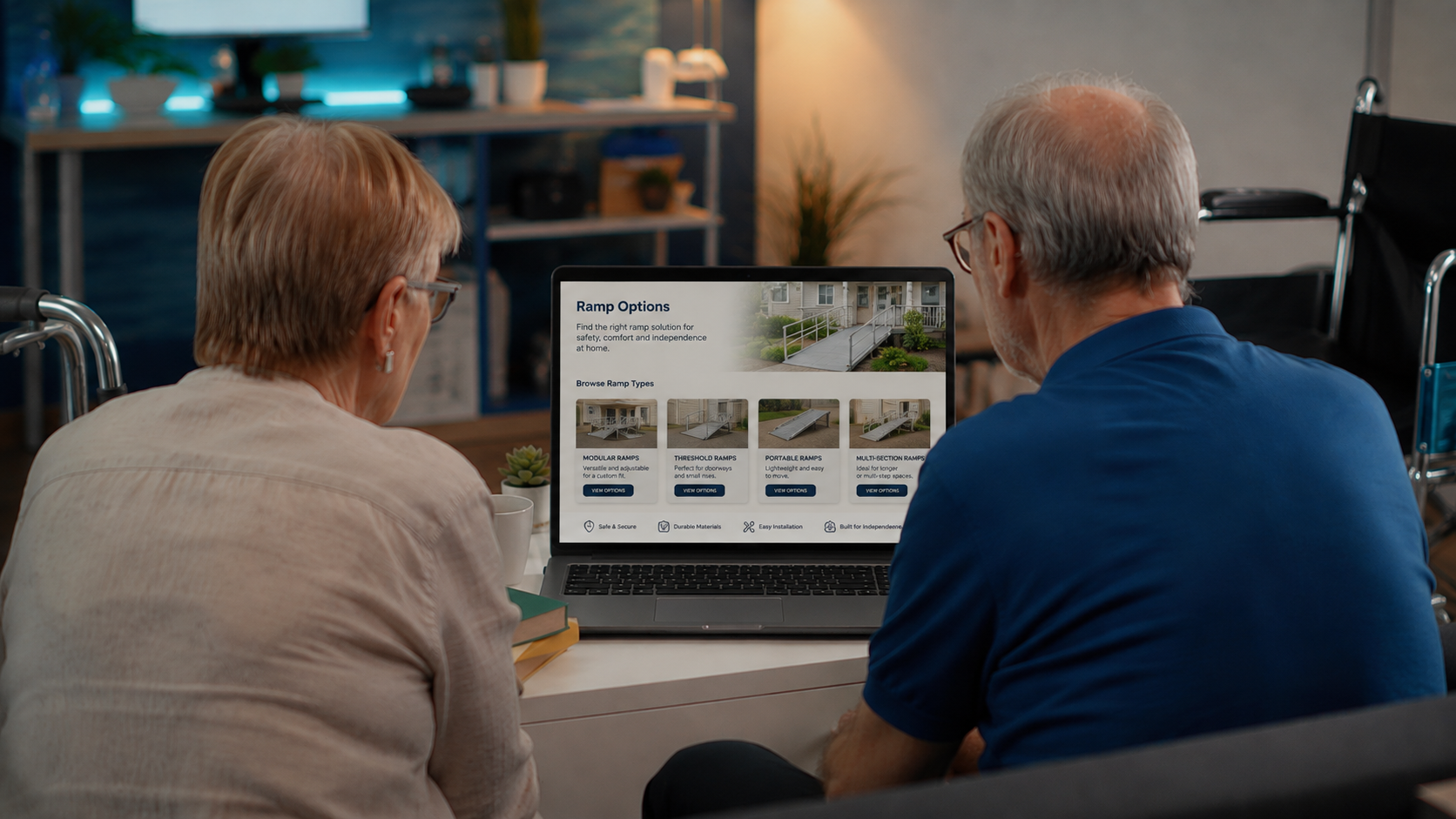
When your home no longer works as well as it once did, a modification can make a real difference.
A wheelchair ramp can make it easier to get in and out of the house. A stairlift can make the stairs manageable again. A few well-placed grab bars can provide more stability in the bathroom. Sometimes, relatively small changes can make everyday life feel much safer and less difficult.
Then comes the question many families find harder to answer:
How are we going to pay for it?
If you’ve found yourself asking that, you’re certainly not alone. The cost of a home modification can be a lot to take on, particularly when you’re already making decisions about the safety, comfort, or independence of someone you love.
And while some families can pay for a project out of pocket, that’s not the only path available.
Depending on where you live and your particular circumstances, you may be able to find grants, loans, assistance programs, veteran benefits, nonprofit support, or other financing options that can help with the cost.
The challenge is knowing where to look and which options are worth exploring.
That’s what this guide is here to help you with.
How Can You Pay for Home Modifications?
There are several potential ways to fund a home modification:
- Home modification grants that may not need to be repaid if you qualify.
- Government loans or low-interest programs for eligible homeowners.
- Veteran-specific housing grants for qualifying service-connected disabilities.
- Medicaid or other health-related programs that may cover certain medically necessary modifications.
- State, county, and local programs for eligible homeowners.
- Nonprofit and charitable assistance for people who meet specific needs.
- Traditional financing or home improvement loans.
- Contractor financing that allows you to pay for an eligible project over time.
The right option depends on your circumstances. There is no single funding source that works for every homeowner.
That is why the first step is not necessarily applying for a grant.
The first step is understanding which types of funding you may qualify for.
1. Home Modification Grants
When people search for ways to pay for accessibility improvements, grants are often the first thing they look for.
A grant can be especially helpful because eligible recipients generally do not repay the grant in the same way they would repay a conventional loan.
However, grants usually have specific eligibility requirements.
You may need to meet requirements related to:
- Household income
- Age
- Disability or medical condition
- Military service
- Location
- Homeownership
- Type of modification
- Health or safety needs
Some grants are also limited by available funding. Being eligible does not necessarily mean funding will immediately be available.
What can home modification grants help with?
Depending on the program, eligible modifications may include:
- Wheelchair ramps
- Stairlifts
- Grab bars and handrails
- Accessible bathrooms
- Doorway modifications
- Mobility-related improvements
- Other accessibility or health and safety improvements
A particularly important point is that not every grant covers every type of home improvement.
A program designed to address accessibility may not pay for a general renovation, cosmetic upgrade, or project unrelated to a documented need.
2. Government Home Repair Loans
If you do not qualify for a grant, a government-backed or government-supported loan may still be worth investigating.
For example, the USDA Section 504 Home Repair program provides loans to eligible very-low-income homeowners in eligible rural areas. Grants may also be available to qualifying elderly homeowners for removing health and safety hazards.
Programs like this can be particularly helpful for homeowners who need important repairs or accessibility improvements but have limited financial resources.
The important thing to remember is that government programs have specific requirements.
You may need to meet income, property, location, credit, age, or other eligibility criteria.
Important: Do not assume you qualify based only on the program name. Check the current requirements for your specific location and situation.
3. FHA and Other Home Improvement Financing
Some homeowners may be better served by financing rather than a grant.
HUD-backed options can include programs designed to help homeowners finance improvements to an existing property.
For example, an FHA Title I Property Improvement Loan can be used for certain home improvements, including improvements intended to protect or improve the livability or utility of a home.
An FHA 203(k) Rehabilitation Mortgage may also be relevant when accessibility work is part of a larger home purchase or rehabilitation project.
These are loans, not grants, so repayment is required.
That distinction matters.
Before choosing any financing option, look carefully at:
- Interest rate
- Monthly payment
- Loan term
- Total amount repaid
- Fees
- Credit requirements
- Whether your home is used as collateral
- Whether the financing covers your entire project
The lowest monthly payment is not necessarily the least expensive option overall.
4. Funding Options for Veterans
Veterans with qualifying service-connected disabilities may have access to some of the most significant home modification assistance available.
The U.S. Department of Veterans Affairs offers programs such as:
Specially Adapted Housing (SAH) Grant
The SAH program can help qualifying veterans and service members modify a permanent home to meet their needs.
For fiscal year 2026, the maximum SAH grant amount is $126,526.
Special Home Adaptation (SHA) Grant
The SHA grant is a separate program with different eligibility requirements.
For fiscal year 2026, the maximum SHA grant amount is $25,350.
There are also provisions for certain temporary residence adaptations.
These programs are not available to every veteran. Eligibility depends on specific service-connected disabilities and other requirements.
If you are a veteran considering a home modification, it is worth checking VA eligibility before assuming you will need to finance the project yourself.
5. Health-Related and Medicaid Programs
Some home modifications may be connected directly to a person’s health or disability needs.
In certain circumstances, Medicaid or Medicaid waiver programs may provide support for medically necessary environmental or home accessibility modifications.
Examples can include:
- Ramps
- Handrails
- Grab bars
- Doorway modifications
- Accessible bathroom features
- Lifts
- Other adaptations related to an individual’s assessed needs
These programs can be complicated because eligibility and coverage depend on the specific Medicaid program, waiver, health needs, and authorization process.
A modification generally cannot be assumed to be covered simply because it is considered an accessibility improvement.
If the modification is related to a medical or disability need, ask your healthcare provider, care manager, Medicaid plan, or relevant program administrator whether home modifications are an available benefit.
6. State, County, and Local Programs
One of the most overlooked sources of assistance is right in your own community.
Cities, counties, towns, housing agencies, and nonprofit organizations may offer home repair or rehabilitation programs for eligible homeowners.
These programs can sometimes include accessibility improvements such as:
- Ramps
- Lifts
- Accessible bathrooms
- Doorway modifications
- Safety repairs
- Other improvements that help a homeowner remain safely in the home
Eligibility may be based on income, location, age, disability, property type, or other factors.
And local programs can change.
Funding can run out. Application periods can close. Eligibility requirements can be updated.
That is why local research should always include checking the current program status directly with the organization administering it.
Not Sure Which Programs Apply to You?
That’s understandable. Funding programs can have very different requirements, and figuring out where you fit can take time.
We’ve put together a Funding Options resource to make that search easier. Start by exploring the programs available based on your location and circumstances, then confirm the current requirements directly with the organization offering the program.
Explore Liv Home Pros’ Funding Options
Home Modification Funding in Rochester, Western New York, and Central New York
If you live in Rochester, Monroe County, or elsewhere in Western or Central New York, local programs may be especially important to investigate.
For example, Monroe County’s Home Improvement Program provides grants or grant/low-interest loans to eligible homeowners in certain suburban towns and villages. The program specifically identifies accessibility accommodations such as ramps, lifts, doorways, and bathrooms as potentially eligible improvements.
However, the program does not cover every part of Monroe County. Residents of the City of Rochester, Greece, and Irondequoit are directed to contact their respective municipalities.
This is an important reminder:
Your address can matter just as much as your income.
Two homeowners living only a few miles apart may have access to different programs because they live in different municipalities.
For homeowners in the Rochester and Western New York area, it can therefore be helpful to look at:
- County programs
- City programs
- Town programs
- New York State programs
- Medicaid or waiver benefits
- Veteran programs
- Local nonprofit assistance
- Regional accessibility organizations
Liv Home Pros has created a dedicated Funding Options resource to help homeowners explore programs by location, eligibility situation, and program type.
Explore Liv Home Pros’ Funding Options
7. Nonprofit and Charitable Assistance
Government programs are not the only place to look.
Some nonprofit organizations provide grants or assistance to individuals with specific medical conditions, disabilities, financial needs, or life circumstances.
These programs may be smaller than government grants, but they can sometimes help fill a gap when a larger funding source does not cover the full project.
Depending on the organization, you may need:
- Proof of financial need
- Medical documentation
- A referral from a healthcare professional
- An estimate or proposal for the project
- Proof of diagnosis or disability
- Proof of residency
Some organizations also have geographic restrictions or specific application periods.
This is why it can be helpful to search beyond broad terms such as “home improvement grants.”
Try more specific searches such as:
“[condition] home modification grant”
“[disability] accessibility grant”
“[city or county] home repair assistance”
“wheelchair ramp assistance [location]”
The more specific your search, the more likely you are to find programs designed around your situation.
8. Financing Your Home Modification
Sometimes the best option is not a grant or assistance program.
It may simply be financing the project over time.
This can make sense when:
- You do not qualify for assistance programs.
- The available grant does not cover the full project.
- You need the modification sooner than a grant program can provide funding.
- You prefer a predictable payment plan.
- You want to preserve your emergency savings.
- The project is important enough that waiting would create additional safety or accessibility concerns.
Liv Home Pros also offers financing through a lending partner, subject to credit approval and applicable terms.
The current financing option can be used for projects up to a specified amount, with repayment terms and APR depending on the approved offer.
If you choose financing, compare the total cost of borrowing, not just the monthly payment.
A lower monthly payment may come with a longer repayment period and a higher total cost.
What If You Need a Wheelchair Ramp, Stairlift, or Bathroom Modification?
You do not necessarily need to start by searching for a program that matches the exact product.
Instead, start with the need.
For example:
“I need a wheelchair ramp.”
Look for:
- Accessibility grants
- Home modification assistance
- Disability-related funding
- Local home repair programs
- Veteran benefits if applicable
- Medicaid or waiver benefits if applicable
- Financing
“I need a stairlift.”
Look for:
- Home accessibility grants
- Disability assistance
- Veteran housing grants
- Local rehabilitation programs
- Nonprofit assistance
- Financing
“I need a safer bathroom.”
Look for:
- Accessibility improvement programs
- Home repair assistance
- Aging-in-place programs
- Medicaid-related benefits where applicable
- Local housing programs
- Financing
This approach helps you avoid limiting your search to one type of funding.
What Information Should You Gather Before Applying?
Funding applications become much easier when you have the basic information ready.
Consider gathering:
About the homeowner
- Full name
- Age
- Household size
- Income information
- Homeownership information
- Veteran status, if applicable
- Disability or medical information, if relevant
About the home
- Property address
- Type of home
- Ownership status
- Location or municipality
- Current accessibility challenges
About the project
- What modification is needed?
- Why is it needed?
- Who will use it?
- Is it related to a disability or medical need?
- Is it related to safety?
- What is the estimated project cost?
Supporting documents
Depending on the program, you may also need:
- Proof of income
- Proof of homeownership
- Medical documentation
- Veteran documentation
- Contractor estimates
- Photos of the existing condition
- Other application-specific documents
You do not need to have everything before you begin researching.
But knowing what information you may eventually need can make the process much less stressful.
Can You Combine More Than One Funding Source?
Sometimes.
A homeowner may potentially combine a grant with another funding source, but this depends entirely on the rules of the individual programs.
For example, one program may allow another source of funding to cover the remaining project cost, while another may prohibit certain types of “stacking.”
Never assume that two programs can automatically be combined.
Before accepting funding, ask:
“Can this funding be used together with another grant, loan, or assistance program?”
That one question can prevent problems later.
What If You Don’t Qualify for a Grant?
Don’t stop there.
Not qualifying for one program does not necessarily mean you have no options.
You may be able to:
- Try another grant program
- Look for a local program
- Ask about health-related benefits
- Explore veteran benefits
- Contact a nonprofit
- Investigate a low-interest loan
- Consider financing
- Break the project into phases
- Combine eligible funding sources
Funding research can take time because programs are designed for different situations.
The goal is not to find the funding program.
The goal is to find the funding options that make sense for your situation.
A Simple Way to Start
If researching funding already feels overwhelming, start with these five questions:
1. Where is the home located?
Your city, town, county, and state can determine which programs are available.
2. Who needs the modification?
Is it for you, a spouse, a parent, a child, or another family member?
3. Why is the modification needed?
Is the primary concern mobility, disability, aging, medical necessity, safety, or another need?
4. Are there eligibility factors that may help?
Consider:
- Income
- Age
- Veteran status
- Disability
- Medical diagnosis
- Homeownership
- Location
5. How much will the project cost?
Once you have an approximate project cost, you can start comparing potential grants, assistance programs, and financing options.
Don’t Let the Funding Question Stop You From Exploring Your Options
If you are researching a home modification for yourself or someone you love, you may already be carrying a lot.
You may be trying to figure out what the home needs.
You may be comparing products.
You may be thinking about safety.
You may be wondering how quickly the modification needs to happen.
And then there is the financial question.
“Can we actually afford this?”
That question matters. But it does not have to be the end of the conversation.
There may be programs you have not heard about yet.
There may be local resources you have not considered.
There may be financing options that make the project more manageable.
And there may be more than one path forward.
Start by learning what is available.
Explore Funding Options for Your Home Modification
Liv Home Pros created a dedicated Funding Options resource to make the research process easier.
You can explore potential programs based on location, income, veteran status, health needs, and program type.
The resource includes federal, state, local, veteran, nonprofit, and other funding opportunities that may help eligible homeowners explore ways to pay for accessibility and home modification projects.
Explore the Liv Home Pros Funding Options guide
If you are ready to talk about what your home may need, Liv Home Pros can also help you evaluate your accessibility challenges and explore potential solutions.
Your home should work for the life you’re living. And finding a way to make that possible should not feel like a second job.
Frequently Asked Questions (FAQs)
Are there grants for home modifications?
Yes. Some government agencies, local programs, veterans’ programs, and nonprofit organizations offer grants or other assistance that may help eligible homeowners pay for certain home modifications. Eligibility, funding amounts, and covered improvements vary by program.
How can I pay for a home modification if I don't qualify for a grant?
You may still have options, including government-backed loans, local home improvement programs, nonprofit assistance, traditional home improvement loans, or contractor financing.
Are there home modification grants for seniors?
Yes. Some programs specifically serve older adults, particularly those who have limited income or need modifications to address health and safety concerns. Eligibility varies by location and program.
Are there home modification grants for veterans?
Yes. The VA offers housing grants for eligible veterans and service members with qualifying service-connected disabilities, including the Specially Adapted Housing and Special Home Adaptation programs.
Can I get help paying for a wheelchair ramp?
Potentially. Wheelchair ramps may qualify under certain home modification grants, Medicaid or waiver programs, veteran benefits, local housing programs, nonprofit assistance programs, or financing options. The right option depends on your location and circumstances.
Can I get help paying for a stairlift?
Potentially. Some funding programs may cover accessibility or mobility-related modifications, while others may provide broader home repair assistance. Veterans and people with certain disabilities may have additional options to investigate.
How do I find home modification funding in Rochester, NY?
Start with programs available through Monroe County, the City of Rochester, your town or municipality, New York State, and other sources such as veteran, Medicaid, and nonprofit programs. Because eligibility and available funding can vary by address and personal circumstances, finding the right program can take some digging.
Liv Home Pros’ Funding Options resource brings many of these possibilities together in one place, so you can explore potential programs based on your location and situation before contacting individual organizations.
Explore Funding Options for Your Home Modification
Once you find a program that may fit, be sure to confirm its current eligibility requirements, funding availability, and application process directly with the organization.
Where can I start looking for funding?
Start with Liv Home Pros’ Funding Options resource, where you can explore potential programs based on your location and circumstances. Then verify the current eligibility requirements and application process directly with the organization administering each program.