

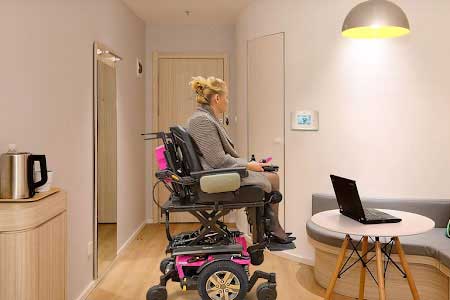
A home doesn’t have to be completely automated to be more accessible. Sometimes, a small technology change turning on a light by voice, unlocking a door remotely, adjusting the thermostat from a phone, or answering the door without getting up can make everyday routines easier.
For people with limited mobility, reduced reach or grip strength, vision challenges, or other accessibility needs, smart home technology can reduce the number of physical tasks required to control the home.
And adoption is growing. AARP reports that 27% of adults age 50 and older owned smart-home safety or security technology in 2025, up from 10% in 2019. AARP also reports that half of adults 50-plus now use at least one type of smart-home technology.
But technology isn’t a substitute for an accessible home. Smart devices can make certain tasks easier, while ramps, stairlifts, grab bars, lighting improvements, and accessible remodeling address physical barriers that technology alone cannot solve.
If you’re planning an accessible home, think of smart technology as one layer of the solution.
How Smart Home Technology Can Improve Accessibility
Smart home technology can improve accessibility by allowing people to control lights, locks, thermostats, doors, window coverings, and other home features through voice commands, smartphone apps, automation, or remote controls. These options can be especially useful for people who have limited mobility, reach, grip strength, or difficulty using traditional switches and controls.
6 Smart Home Technologies That Can Support Accessibility
Voice Activation
Using voice activation through technologies such as Amazon Echo and OK Google can not only turn any home into a Smart Home – but make living safely and independently a reality for people of all abilities. This technology allows you to control appliances in your home, apartment, or workspace via voice commands or through the companion app you can download to your smartphone. With ever increasing integration into the internet of things, the possibilities are truly endless for connecting with your world.
Smart Locks
Using a smart lock in your home is safer than using a simple keypad, especially if you need to offer housekeepers, therapists, and nurses access to your home. For example, a keypad won’t be able to tell you who it has let in and can’t automatically change the combination to keep your home secure. Plus, as soon as someone knows the combination, they can enter your home. One of the best smart locks on the market is the August Smart Lock, which uses smartphones as “keys.” You can also view a log of who entered your home and restrict access to certain users.
Smart Video Doorbell
For people that can’t come to the door because of illness or disability, a smart doorbell is a worthy investment to let you know who’s at the door. One of the best smart doorbells on the market is the Ring smart doorbell that has a built-in motion sensor camera to identify whose at the door and lets you answer from your couch. Utilizing 1080HD video, you can monitor your home directly through your smart device from virtually anywhere.
Smart Thermostat
Further integration with a smart thermostat can help keep your home at the perfect temperature without even needing to touch it. Although changing the temperature is no hard task, people who can’t reach the device from a wheelchair can benefit from a smart thermostat which can be controlled via a smartphone or tablet. Also, the smart device will learn when to raise and lower the temperature, as well as help you save money on energy costs.
Smart Lighting and Outlets
Not having visibility in your home can be putting yourself at risk. However, by installing smart lighting and outlets, you can prevent this problem and improve visibility in your home. Besides being able to control your outlets and lighting by a tap of your smartphone, you can change the colors of the lighting in your home and set them on timers, so they don’t run all night. One of the best smart lighting systems on the market is Philips Hue, which is not only affordable, but also incredibly functional.
Smart Curtains, Shades or Blinds
If your mobility is restricted, it can be difficult to open and close curtains, shades, and blinds. However, with smart window coverings, it is much easier. Not only is operation simpler, but controlling natural light in your home is easier, too. You can operate them with the touch of a button on an app. A few great options include Slides, My Smart Blinds, and Soma smart shades.
Smart home tech makes it easier for people with different levels of ability to live and thrive independently. This is perhaps the most wonderful thing about new tech advancements making their way into the home. Each smart home ecosystem is different and capable of being customized to meet all people’s needs, regardless of age, ability, or motor function. If we continue heading in this direction with smart home tech, we will absolutely be on our way to Moving Life Forward for all.
Smart Home Technology Is Not a Replacement for Physical Accessibility
Smart technology can reduce the effort required to perform many everyday tasks, but it cannot remove every physical barrier in a home.
A voice assistant can turn on a light, but it cannot make a staircase accessible. A smart lock can simplify entry, but it cannot prevent a fall in the bathroom. A smart thermostat can be controlled remotely, but it does not address an inaccessible room layout.
For that reason, smart technology works best as part of a broader accessibility plan that addresses the home’s physical environment as well as the way its technology is controlled.
Building an Accessible Smart Home in Rochester, NY
If you’re planning accessibility improvements in a home in Rochester or elsewhere in Western New York, smart technology can be considered alongside physical modifications. The right combination depends on the home’s layout, the person’s mobility and accessibility needs, and the tasks they want to make easier.
Liv Home Pros focuses on physical accessibility solutions including ramps, lifts, grab bars, lighting, and accessible remodeling. Smart-home technology can complement these improvements by making everyday controls easier to manage.