

Written by guest author Micah Bellman-Micah.Rakoffbellman@healthcraftproducts.com
Do I really need a grab bar?
If you don’t need a grab bar right now, you probably will at some pointand that’s okay! The reality of being human is that we all experience changes to our mobility eventually. Installing grab bars before you need them will reduce your safety risks long-term.
What is a grab bar?
Before we go further into the why of grab bars, we need to know what we’re talking about. Many dictionary definitions of grab bars are explicitly tied to bathrooms—but grab bars can be useful in a lot more spaces.
We liked this definition from Wikipedia because it takes a broader approach:
“Grab bars are safety devices designed to enable a person to maintain balance, lessen fatigue while standing, hold some of their weight while maneuvering or have something to grab onto in case of a slip or fall. A caregiver may use a grab bar to assist with transferring a patient from one place to another. A worker may use a grab bar to hold on to as he or she climbs, or in case of a fall.”
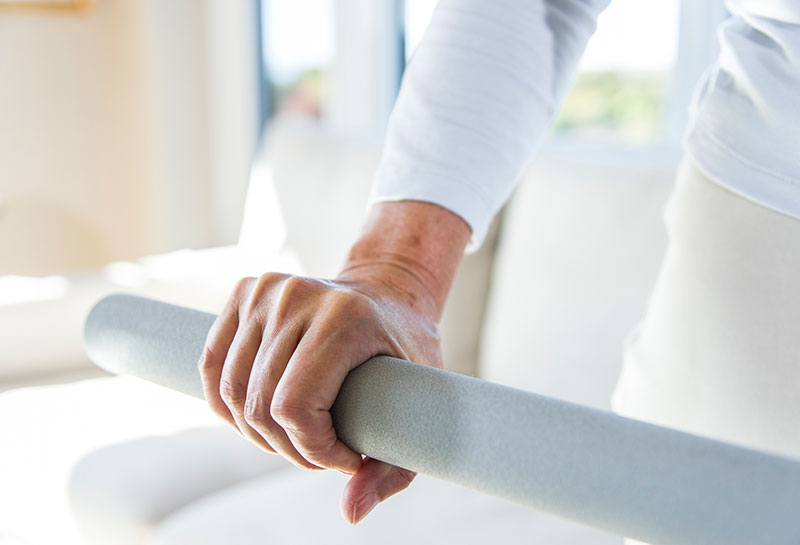
Traditional fall prevention grab bars tend to be sturdy metal tubes attached to walls that people use for added support in spaces with potential hazards.
How do grab bars help prevent falls?
There are three main ways grab bars help prevent falls
- Providing support for balance: If you have trouble balancing, holding onto a grab bar can help you maintain your balance and reduce fatigue while standing.
- Providing support during transfers: A transfer is any change of position. Some common examples include getting on or off the toilet or in and out of the bath. As people age, it’s normal for these types of transfers to become more difficult. A well-placed grab bar can make transfers easier and safer.
- Providing a fail-safe: As a last resort, a grab bar can prevent a fall in progress by giving you something to grab onto before you hit the floor.
Why you might need grab bars
Here’s a not-so-radical truth: everyone gets older. As we age, our bodies change, and certain activities become more challenging. Regardless of your age, you’ve probably experienced changes to your level of ability at some point. Maybe you’ve broken bones and been temporarily in a cast. Perhaps after a lot of driving, you’ve had back pain so bad you couldn’t move. The point here is that all of us have been in situations where the regular tasks we take for granted become more difficult or dangerous. Having grab bars for extra support could be the difference between staying safe and suffering a fall in these situations.
The epidemic of falls
They’re not talked about enough, but falls are a huge problem that affects everyone. According to a 2014 study by Centers for Disease Control and Prevention, falls are the leading cause of fatal and nonfatal injuries among adults aged 65 and older. Approximately one-third of seniors have a fall each year, but less than half tell their doctor. Worse, a person’s risk of falling doubles if they’ve fallen once before. If you’re under 65, you might not think you need to worry about falls, but their impacts are far-reaching.
Falls place a tremendous financial burden on the medical system. In the US in 2015, the total medical costs for falls were over $50 billion. These statistics are just the tip of the iceberg when it comes to falls, and they don’t account for the long-term impact family members endure when their loved ones fall. The worst part is that falls are very preventable, but because of stigma and shame, people are reluctant to accept safety solutions like grab bars.
The stigma around grab bars
Before we go any further, let’s think about some safety solutions that are widely accepted. We use seatbelts when driving, handrails on stairs, and helmets when cycling—so why is it so hard for us to accept grab bars in wet, slippery bathrooms? In reality, the stigma around grab bars is just part of the stigma around aging and disability. Engineer and occupational therapist Rebecca Langbein sums this up in a fall 2020 interview:
“There’s no denying we live in an ageist world. We’re taught from the time we’re really little, “enjoy life when you’re young; everything gets worse when you get older!”
Even though aging and the changes that it brings are pretty much universal, they are seen in a negative light, so anything that draws attention to them (like grab bars) might be challenging to accept.
Traditional grab bars (and many other safety products) also have a reputation for looking very clinical. In addition to feeling ashamed about your age or level of ability, you probably don’t want products in your home that make it look like a hospital. Beyond the stigma around aging, disability, and grab bars, people tend to feel embarrassed about asking for help or support in general. In western culture, self-sufficiency is seen as one of the highest virtues. As a result, asking for help is seen as a weakness. This belief in fierce independence can be toxic in many ways, but in the context of grab bars, it’s just ironic.
If we all felt less shame about aging, disability, and safety, maybe we’d see grab bars and safety products become standard fixtures everywhere. Perhaps it wouldn’t be so scary to ask for the support we need. As a result, maybe we’d all be able to stay independent and self-sufficient for longer.
Proactively installing grab bars (and overcoming the stigma)
It’s natural that you might feel ashamed about your changing needs, but you shouldn’t have to. If we’re lucky enough to live to old age, all of us will deal with varying need, and that’s okay!
What’s important is that whatever your needs (or the needs of your loved ones), you’re able to live with comfort and dignity without worrying about your safety. Even if you feel like it’s too soon to install grab bars, taking a proactive approach has several benefits.
First, your home will be safer for everyone. If you have older friends and family who visit you or share your space, having grab bars will ensure their comfort and safety in your home. Another benefit to installing grab bars before you need them is that you won’t ever be in a rush to install them in reaction to a fall or injury.
Finally, you (and your loved ones) won’t have to worry about your safety long-term. You can have peace of mind that your space will work for you as you age, and you’ll probably be able to avoid some difficult conversations about safety. If you feel embarrassed talking about this, installing safety products means you won’t have to.
Even if you don’t choose to install grab bars in your home right now, you should understand why it’s an important step. We hope that once you feel ready, that understanding makes your decision easier.
Frequently Asked Questions (FAQs)
Do I really need a grab bar in my bathroom?
If you don’t need a grab bar right now, you will at some point and that is okay. The more important question is: why wait for a fall or a close call to install one? Grab bars are among the most cost-effective fall prevention tools available. According to the CDC, falls are the leading cause of injury for adults over 65, and the bathroom is one of the highest-risk locations in the home. Installing grab bars before you need them means your home is safer for visitors, you are never in a rush after an incident, and you do not have to worry about your safety as you age. The stigma around grab bars is real, but so are the falls they prevent.
Why do people resist installing grab bars?
The primary barrier is psychological, not practical. Research published in Frontiers in Public Health found that 65.4% of households did not have a grab bar, despite the fact that 88.5% of respondents said they would allow one to be installed at no cost. The main reasons for resistance are the stigma associated with aging and disability, the belief that grab bars look clinical or institutional, and the western cultural value of self-sufficiency. In reality, grab bars are no different from seatbelts, handrails on stairs, or helmets when cycling- safety tools we accept everywhere except the bathroom.
Where should grab bars be installed in a home?
The highest-priority locations for grab bar installation are: inside the shower (at entry and along the wall for standing support), outside the shower or tub (at the step-in/step-out transition), next to the toilet on both sides, along the hallway between bedroom and bathroom (especially for nighttime trips), and at all interior and exterior entry steps. The specific placement should be customized to the user’s height, mobility, and daily movement patterns. A CAPS-certified specialist can determine the optimal placement during a free home assessment.
Are suction-cup grab bars safe?
No. Suction-cup grab bars are not rated for full weight-bearing use and should not be used as a fall prevention tool. They are designed for temporary, light-duty use only. In a fall, a person can exert 250 lbs or more of sudden force on a grab bar. That is far more than any suction mechanism can safely hold. Properly installed grab bars are anchored into wall studs or structural backing and are rated for full body weight. Liv Home Pros only installs structurally anchored grab bars for this reason.
Do grab bars have to look clinical or institutional?
No. Modern grab bars are available in a wide range of decorative finishes such as brushed nickel, matte black, oil-rubbed bronze, polished chrome, and more, that match standard bathroom hardware. Many are visually indistinguishable from towel bars, and some models serve as both. A bathroom with well-placed, decorative grab bars does not look like a hospital room. It looks like a thoughtfully designed bathroom. Liv Home Pros offers multiple finish options that complement any bathroom style.
Is it better to install grab bars before or after a fall?
Before, always. Installing grab bars proactively means the home is safer for everyone immediately, you are never in a panic trying to modify the home after an injury, and you avoid the physical and emotional cost of a fall that a grab bar might have prevented. Aging-in-place specialists consistently find that families who act before a triggering event maintain independence significantly longer than those who wait. The cost of a grab bar installation is a fraction of the cost of a single fall-related emergency room visit.
Does Liv Home Pros install grab bars in Rochester, NY?
Yes. Liv Home Pros is Rochester’s CAPS-certified home accessibility specialist, installing professional grab bars and handrails throughout Monroe County and surrounding Western and Central New York. Every installation is anchored into wall studs for full weight-bearing safety. We offer free home assessments with written quotes at no obligation. Call 585-203-9200 or visit livhomepros.com/contact/ to schedule.